Cyber Story Cards — Learn Digital Security Through Play
How do you explain cyberbullying to a 7-year-old? How do you help a child understand that an online stranger cannot be a real friend? These are the questions that led Cyber Sqool to develop the Cyber Story Cards: an educational tool that turns complex digital safety concepts into engaging visual stories, accessible from age 6.
What are the Cyber Story Cards?
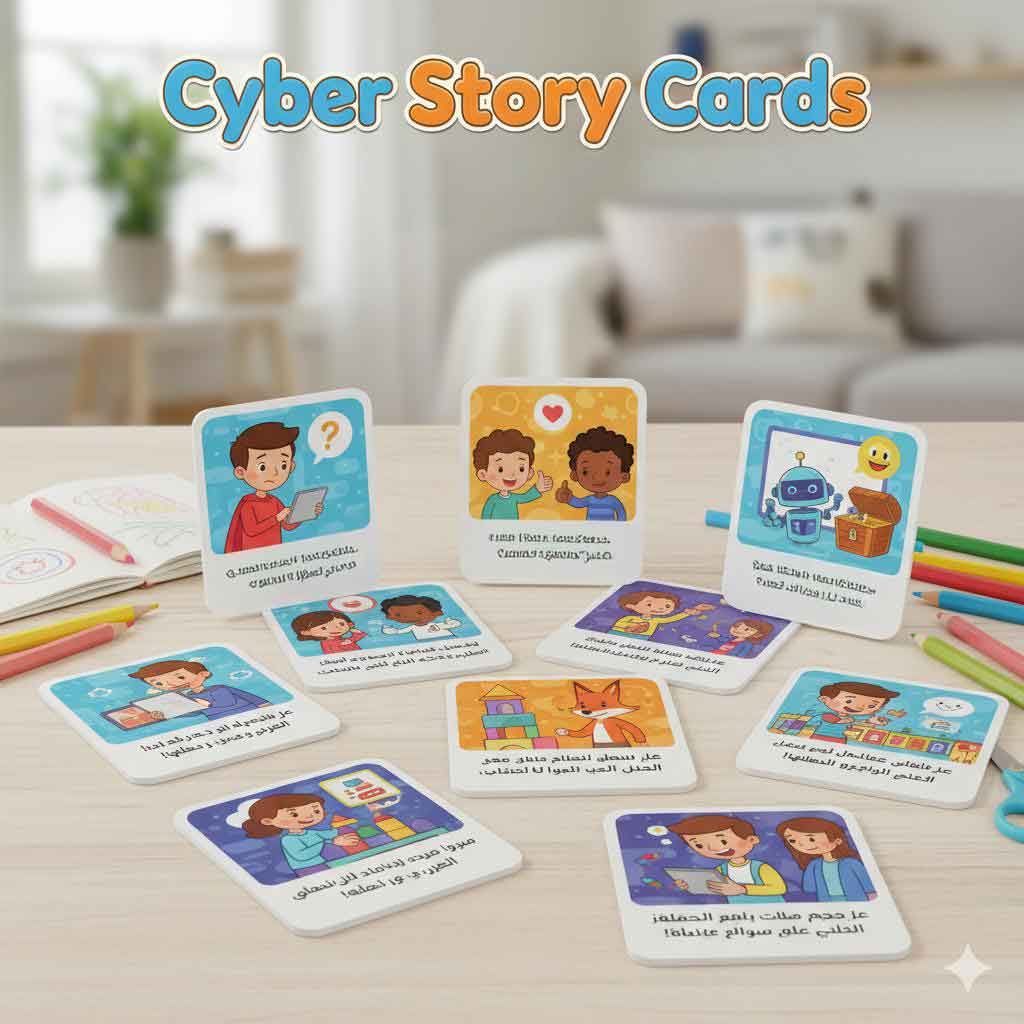
The Cyber Story Cards are a set of narrative cards designed to introduce children to digital safety through storytelling. Each card presents a character, a situation, and a choice — the right one and the wrong one. Children reflect, discuss, and find the best response. The set covers 6 key themes:
- Online privacy — What is personal information? Who has the right to know it?
- Digital strangers — Why an adult wanting to be friends with a child online should trigger alarm bells
- Cyberbullying — Recognising it, reacting, and knowing who to tell
- Passwords and security — Why you never share your password, even with a friend
- Misinformation — How to check whether what you read online is true
- Screen time — Finding balance between online and real life
Why storytelling is the most effective approach
Children learn through example and emotion. Research in educational neuroscience (Immordino-Yang, USC, 2022) shows that stories activate more brain regions than direct instruction, creating longer-lasting memories and more deeply embedded behaviours. Instead of a lecture on “don’t talk to strangers online”, the Cyber Story Cards show Yasmine, age 8, receiving a strange friend request — and ask what the child would do in her place. It stops being an abstract rule and becomes a story they lived through.
The 6 themes in depth
Each theme is developed across several cards of increasing difficulty, allowing age-appropriate progression:
- Beginner level (ages 6-8): Simple situations with clear choices — share your address with a stranger, or not?
- Intermediate level (ages 9-11): More nuanced situations — an online “friend” asking for photos, a rumour spreading on social media
- Advanced level (ages 12-14): Complex dilemmas — peer pressure to share content, influencer manipulation
How to use them at home
- As a family game night — 20 minutes of cards replaces a TV session. Each child draws a card and explains how the character should react.
- In the car — Read a card aloud and ask your child to choose an answer. Perfect for journeys.
- As a “digital licence” — Use the cards before granting a child their first internet access.
- To reinforce Cyber Sqool courses — The cards anchor platform learning by replaying it in a playful context.
Measured classroom impact
During Cyber Days in partner schools across Morocco and France, the Cyber Story Cards were tested with over 1,500 students. 94% of teachers said students retained safety rules better after a card game session than after a traditional lesson. This isn’t a gimmick — it is proven pedagogy. Digital safety is not a set of rules to memorise. It is a way of thinking, and the Cyber Story Cards are one of the best tools for teaching it.