Why your child needs more than a traditional digital school
Your child learns to cross the street. They learn not to talk to strangers outside. They wear a seatbelt. But have you taught them to safely navigate the internet? In a world where Moroccan children spend over 5 hours per day on connected devices (ANRT, 2024), digital education is no longer optional — it is as essential as road safety education.
Why digital education cannot wait
Moroccan children connect early. Very early. According to a UNICEF MENA study (2023), the average age of first internet access in Morocco is 8 years old. The average age of creating a first social profile is 10 — below the 13 years required by most platforms.
Meanwhile, risks only increase:
- Cyberbullying: 1 in 4 children in Morocco has already been harassed online (Defence for Children International – Morocco, 2023)
- Grooming: gaming and messaging platforms are the primary locations for first abusive contact
- Inappropriate content: unsupervised algorithms expose children to violent, sexual, or extremist content
- Scams and phishing: children are the most vulnerable targets of digital scams
What Cyber Sqool offers that school does not
The Moroccan school curriculum does not include a module dedicated to emotional cybersecurity. This is not a criticism — it is a reality shared by many education systems worldwide. Cyber Sqool fills this gap with:
- Age-appropriate content — The risks facing a 7-year-old are not the same as those facing a 14-year-old. Cyber Sqool pathways are built for each developmental stage.
- A multilingual approach — Content available in French and Arabic, designed for Moroccan and North African families.
- Tools for parents — Cyber Sqool doesn’t just train children. Parent guides accompany each theme, allowing parents to extend learning at home.
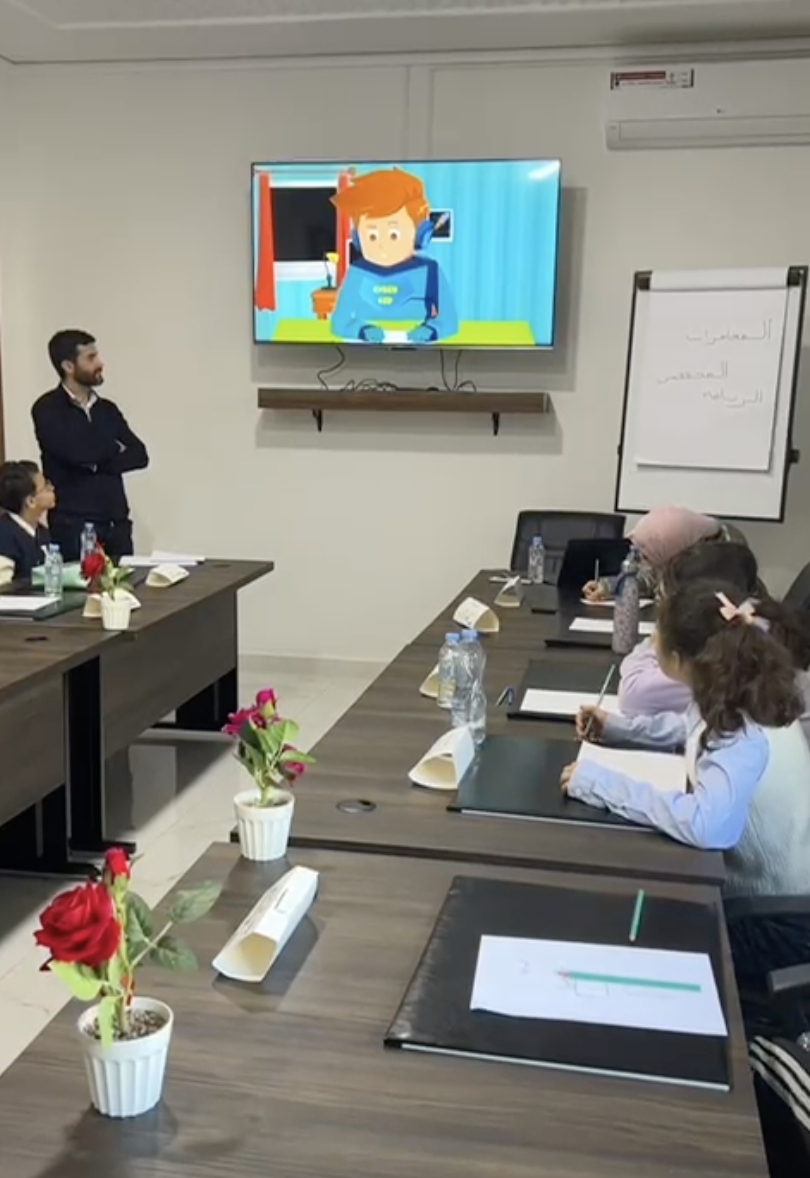
- Interactive, not lecture-based — Videos, quizzes, scenarios, role-play. The child doesn’t listen — they do, choose, and learn through experience.
The 6 skills Cyber Sqool develops
- Identifying online danger — Recognising suspicious behaviour, inappropriate content, or abnormal requests
- Protecting privacy — Understanding what personal data is and how to protect it
- Managing digital presence — Understanding the digital footprint and its long-term consequences
- Responding to manipulation — Knowing how to say no, block, report, and speak to a trusted adult
- Evaluating online information — Distinguishing facts from opinions and lies
- Using screens in a balanced way — Integrating technology as a tool, not a dependency
When to start?
The question is not whether your child will be exposed to digital risks — it is when. And the answer is: probably already. The best protection does not come from filtering software or screen time limits — it comes from a child who can recognise danger and knows they can talk about it. Cyber Sqool builds that skill, one module at a time.